
A Strategic Funding Boost: Students Ask for $5,000; Donors Give Them $13,000
Philanthropy Council donors up the ante for students, enabling an undergraduate team to build a scalable testbed for near-supersonic flight research.
When four Embry-Riddle undergraduates pitched the Philanthropy Council for $5,000 to develop a high-speed unmanned aircraft, Council members saw an opportunity to expand what the project could actually deliver—and awarded them $13,000 instead.
The students had proposed designing, building and flight-testing an experimental aircraft from scratch. By more than doubling the request, the Council removed the team's biggest technical bottleneck: propulsion. With the expanded budget, the students acquired a KingTech K-450G5 turbojet, giving their aircraft the power required to push closer to the speed of sound and gather meaningful flight data.
“The Council was truly impressed by your presentation, your enthusiasm and the vision you shared,” Lisa Rivey, director of philanthropic organizations, wrote in an email announcing the decision. “It’s not often that a project receives more funding than requested, and I hope you recognize what a wonderful reflection this is of the Council’s confidence in your work!”
For lead engineer Jenna Lyons (pictured above, right), the chance to launch an applied research program from the ground up wasn’t something she pictured when she arrived at Embry-Riddle, an opportunity she credits directly to the Office of Undergraduate Research and the Philanthropy Council.
“When I chose Embry-Riddle 3 years ago, I never imagined that I would have the chance to be a part of such riveting, cutting-edge research,” Lyons says. “But now, not only did I have the opportunity to be a part of it, but I also had the incredible opportunity to help design and create a new project.”
From Digital Simulation to Real-World Flight Data
Dubbed PHOENIX—short for Platform for High-speed Operations, Envelope Normalization, and Integrated eXperiments—the project brings together an interdisciplinary student team. Lyons works alongside fellow aerospace engineering students Jackson McWhorter, a member of the Embry-Riddle Rocket Propulsion Lab, and Dylan Frey (pictured above, center), who brings hands-on flight experience to the build. Team lead Conner Sennott (pictured above, left) studies aeronautical science, holds a private pilot certificate and has conducted undergraduate research through Project BURST.
Operating near the speed of sound remains one of the most challenging frontiers in aviation. As an aircraft approaches Mach 1, shifting airflow dramatically alters stability, control response and structural stress. Because full-scale, high-speed flight testing is prohibitively expensive, PHOENIX gives Embry-Riddle a cost-effective, reusable platform to validate designs and collect real-world performance data in this critical flight regime.
Using the Banshee Jet 80+ swept-delta aircraft as an aerodynamic baseline, the team is moving systematically from simulation to flight. They are refining the airframe through computer modeling and 3D printing (illustration below), integrating the new turbojet with onboard systems, and validating their predictions in Embry-Riddle’s wind tunnels before taking the aircraft into flight testing.
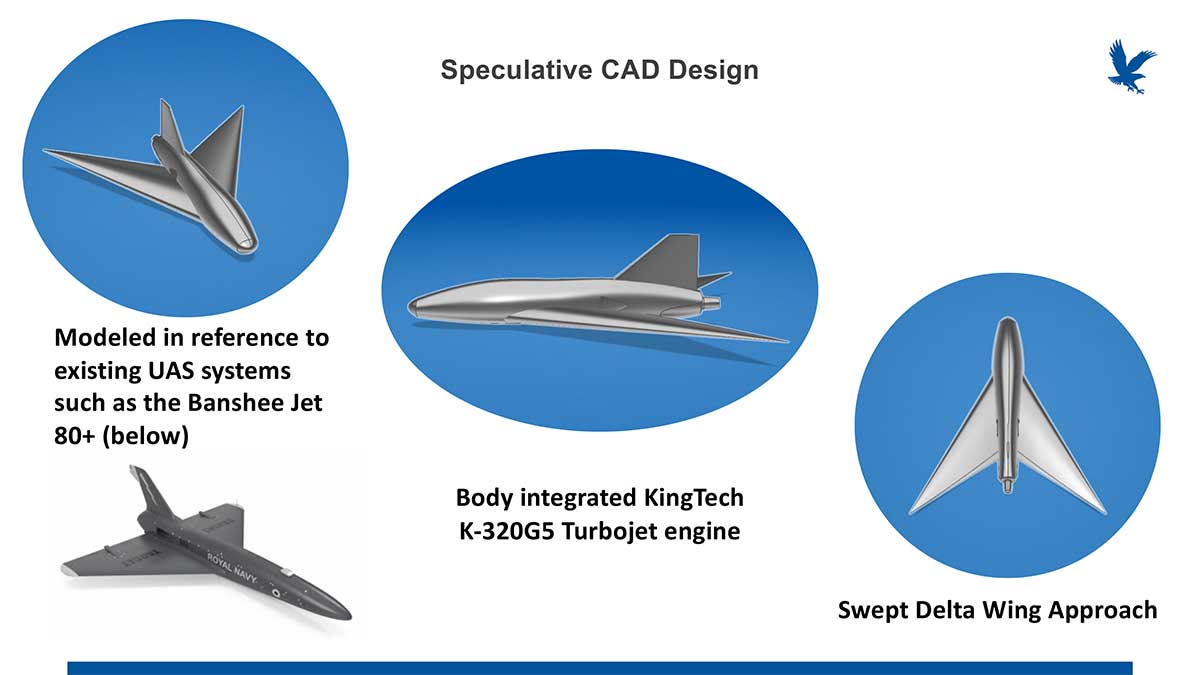
At the same time, Sennott is tackling a major industry-wide hurdle: navigating FAA regulations and establishing an operational framework to safely fly a high-speed unmanned aircraft within the National Airspace System.
“Solving the operational framework and regulatory processes required for a high-speed unmanned aircraft is one of the largest challenges our team faces,” Sennott says.
A Foundation for Breakthroughs
Rather than treating PHOENIX as a one-off student build, the team is designing it as permanent seed infrastructure for an undergraduate transonic flight research lab at Embry-Riddle. Future cohorts will inherit a proven airframe baseline, baseline flight data, and an established FAA compliance playbook.
“If we can standardize the process and conquer the hurdles now, other students can work on pushing the aircraft's performance even further rather than starting from zero,” Sennott says.