
Model Will Gauge Solar Storm Risk to Google Undersea Cables
With a $100,000 research award from Google, a custom modeling tool will be tested against real-world data from operating internet cables.
Embry-Riddle researchers have built a tool to help Google assess how solar storms could affect the undersea cables that carry its internet traffic. Now, a $100,000 gift from the company will put that tool to its most important test: comparing its predictions with measurements from cables in operation.
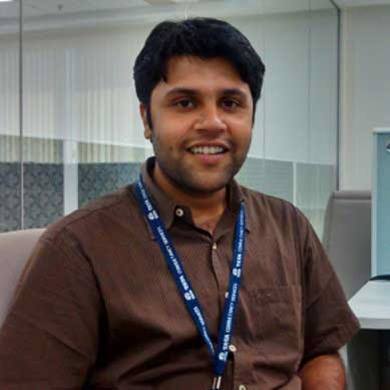 Led by Shibaji Chakraborty (right), a research scientist with the university’s Center for Space and Atmospheric Research (CSAR) on the Daytona Beach Campus, the project focuses on infrastructure that carries more than 97% of international data traffic. These submarine cables connect continents, supporting everything from financial transactions and video calls to cloud computing and the data centers behind artificial intelligence.
“What draws me to this work is the distance it spans,” Chakraborty says. “A disturbance that starts 93 million miles away on the sun ends up as a measurable electrical stress on a cable sitting on the ocean floor.”
Solar storms have already produced electrical disturbances in undersea cables. The challenge is predicting how much stress those disturbances could place on today’s systems and identifying which cables face the greatest risk.
A Threat to the Power, Not the Fiber
The vulnerability lies not in the optical fibers carrying the data — light is unaffected by magnetic fields — but in the electrical system that keeps the signals moving.
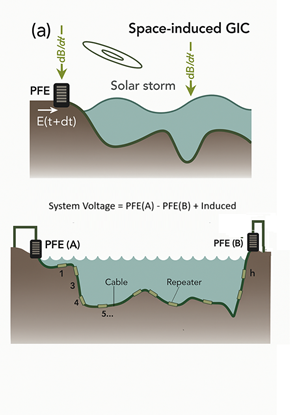 Devices called repeaters, spaced roughly every 50 to 80 kilometers, boost the optical signal across thousands of miles of ocean (see illustration, right). They draw power from metallic conductors running the length of the cable. When solar storms disturb Earth’s magnetic field, those conductors can pick up induced electrical currents. In effect, the cable becomes a giant antenna stretched across the seafloor and grounded on different continents.
A storm on Feb. 11, 1958, shows what that can look like. It drove voltage swings of roughly 3,000 volts in either direction on the transatlantic TAT-1 cable within a single hour. Using historical magnetic observatory data, Chakraborty’s team reconstructed the event and matched the recorded voltage swings to within about 15%.
The result demonstrated that the model could reproduce the effects of an actual storm, not just a simulated one.
Such powerful storms are uncommon, but their consequences could be significant, particularly for long transatlantic and trans-polar routes. Assessing that risk requires reliable predictions backed by operational data.
Built for Google’s Cables
The team’s modeling system, Submarine Cable Upset by Auroral Streams, or SCUBAS, combines magnetic-field observations with cable routes and specifications to estimate voltages generated during geomagnetic disturbances.
The original SCUBAS is a general-purpose, open-source toolbox designed to work with submarine cable routes worldwide. It continues to evolve through research partnerships with Clemson University, the Space Science Institute and Natural Resources Canada.
Over the past 10 months, Chakraborty has built on that foundation to create a custom version of SCUBAS designed around Google’s cable systems, working with Urs Hölzle, one of Google’s earliest employees and a longtime leader of its technical infrastructure.
Google’s $100,000 award will help move the technology from academic research toward practical application.
The project will examine 12 submarine cable systems across different geographic regions and operating conditions. Google will supply operational voltage measurements under confidentiality agreements, allowing researchers to compare the model’s predictions with electrical behavior on working cables.
“That’s the difference between a model that’s theoretically sound and one that’s been tested against the real world,” Chakraborty says.
Planning for Rare, Powerful Storms
The researchers will also reconstruct historical geomagnetic disturbances and simulate extreme events, including storms comparable to the Carrington Event of 1859, one of the most powerful solar storms on record.
Collaborator Lidia Nikitina, a mathematician and statistician affiliated with Trent University in Canada, will use the modeling results to examine how rare, high-magnitude storms compare with the historical record and what they could mean for worst-case planning.
For Google, the findings could help engineers assess the vulnerability of existing cables and account for space-weather risks when planning new ones.
From Research to Real-World Protection
For Embry-Riddle, the award brings an opportunity that conventional academic research rarely provides: access to operational measurements from cables carrying global internet traffic.
Those measurements will allow researchers to test and refine a tool they have already developed, strengthening its potential usefulness to engineers responsible for critical infrastructure.
The benefits will extend well beyond Google. The team plans to release improvements to the SCUBAS software and supporting materials publicly while protecting Google's confidential operational data. Other researchers and cable operators could then use those advances to investigate risks to their own systems.
“Getting to test our model against real Google cable measurements … is a rare chance to turn something that’s mostly been theoretical risk into something we can actually quantify,” Chakraborty says.
Google’s investment will allow Embry-Riddle researchers to test their predictions against working cable systems — a step toward giving engineers a clearer picture of where solar storms could put those systems at risk.